Last Updated on July 22, 2026 | Published: July 22, 2026 published by Jenny Tomei
Private ADHD Assessments in the UK: What a Good One Actually Looks Like
If you’ve looked into getting an ADHD assessment recently, you’ll already know the landscape is confusing. Waiting lists for NHS assessments can run into many months, private providers charge wildly different prices, and it’s genuinely hard to tell a thorough, high-quality assessment from a rushed one.
On a recent episode of the JenUp Podcast, I sat down with David Wharton, a consultant counselling psychologist registered with the HCPC. David spent over 24 years in the NHS, including 13 years in a specialist team assessing adults with ADHD, autism and Tourette syndrome, before moving into private practice through Clear Sky Therapies. I had my own ADHD assessment with David, so this conversation was personal for me too.
This episode struck a nerve with our audience; the clip we shared got over 4,000 views on Instagram in a matter of days, so we wanted to turn it into something you can come back to. Below, David explains what separates a good private ADHD assessment from a poor one, how the NHS Right to Choose scheme actually works, why ADHD so often gets missed in women and girls, and what the diagnosis process can feel like emotionally.
Why private ADHD assessment quality varies so much
One of the most eye-opening parts of our conversation was just how much private assessments can differ, even when they cost the same. David has seen companies charging around £1,500–£1,600 for an assessment that, in his words, doesn’t reflect a much better process than a cheaper alternative. Price alone doesn’t tell you much about quality.
David’s own assessments typically run around three hours. In the NHS, he was given a fixed two hours to complete an assessment and feed back the outcome in the same sitting already tight, but still built around a proper structure. What worries him is that some private and NHS-funded Right to Choose providers are doing the entire process, screening included, in a fraction of that time.
He shared an example from his own family of clients: a man who came in supporting his brother through a Right to Choose assessment. The brother had done all his pre-screening through paper forms, with no direct contact with an assessor, and his actual appointment with the diagnosing professional lasted just 20 to 30 minutes. He came away doubting his own diagnosis.
David was also candid about reviewing private reports during his time in the NHS. His team rejected around half of the private assessment reports that came through, because they were too thin to tell whether a proper assessment had actually taken place. He mentioned one company later sold for a reported £20 million whose reports ran to less than three pages, with only one page of information specific to the individual client.
What a thorough ADHD assessment should actually include
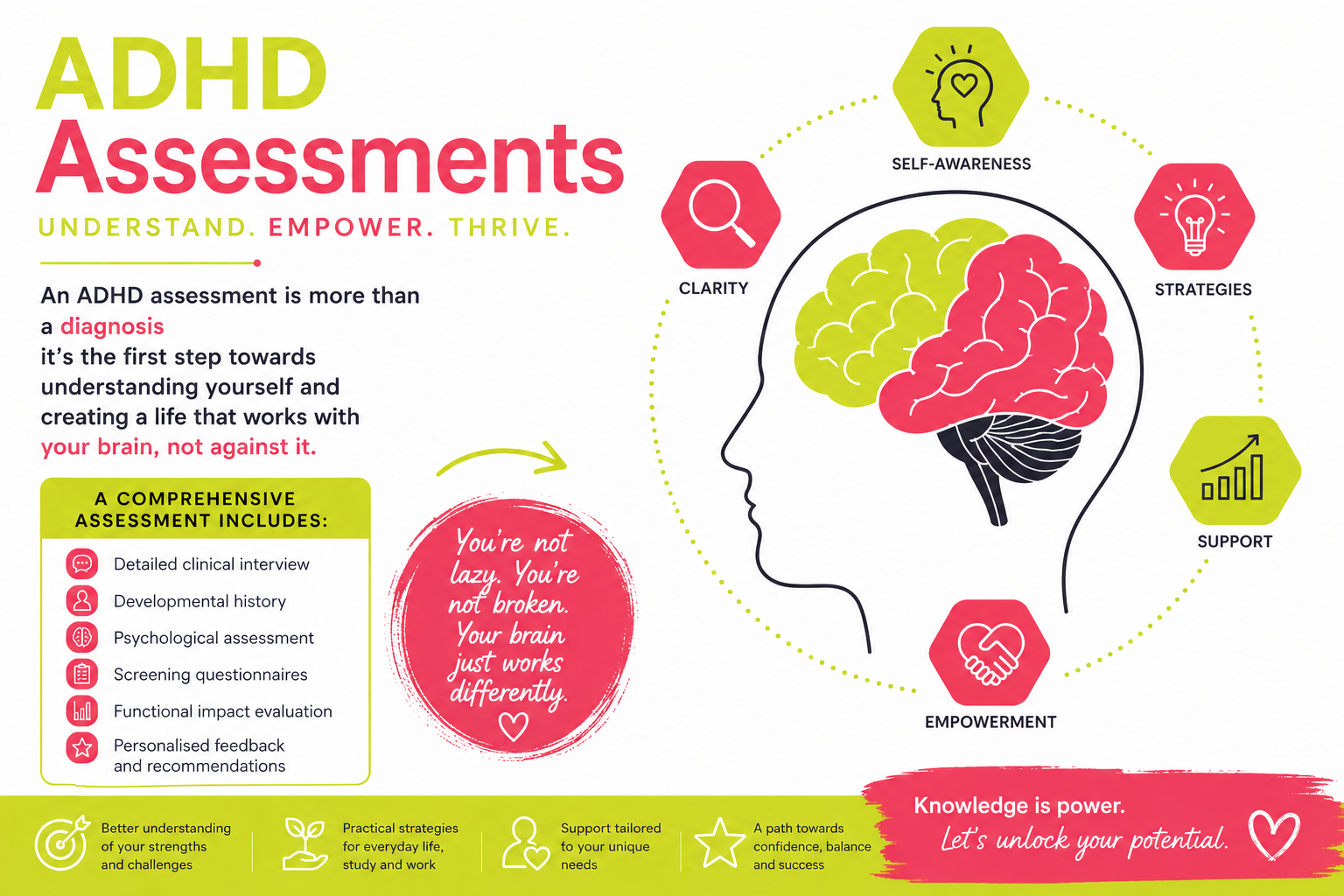
So what should you be looking for? David was clear that quality comes down to time, structure and depth, not price.
It should take at least two to two and a half hours
The most widely used ADHD assessment tool, the DIVA-5, is a structured symptom checklist that looks at how ADHD symptoms showed up in both childhood and adulthood. On its own, the DIVA takes around 90 minutes and that’s before you add the wider psychiatric assessment it’s meant to sit within, covering mental health, risk, physical health and other possible explanations for someone’s difficulties. As David put it, if the DIVA alone takes 90 minutes, an assessment lasting less than two hours in total should raise a question: what’s being left out?
It should include a proper screening stage
A good assessment starts with screening not just to confirm ADHD is likely, but to rule out other explanations. David gave the example of a client with a complex history involving family trauma and possible parental alcoholism, where ADHD and autism traits were present but other factors couldn’t be ruled out. Rather than push ahead, David recommended trauma therapy first, so a clearer picture could emerge later. He said he rarely fails to diagnose someone once they’ve reached full assessment, precisely because thorough screening filters out cases where ADHD isn’t the best explanation before they get that far.
It should look at more than one area of your life
ADHD needs to show up across multiple areas of someone’s life home, relationships, education or work not just in the areas where it’s easiest to spot. Some people manage brilliantly in a job or hobby they’re passionate about while struggling significantly at home, and a good assessor will explore all of it, not just where the symptoms are most visible.
It should include an attention test, administered by a person, not just a score
David uses a test called the Test of Everyday Attention. He was clear it isn’t a perfect measure on its own — what matters as much as the score is how someone performs it. He described a client who scored at the top on every measure but talked constantly, fidgeted throughout, and made mistakes because he was moving so fast. The score alone would have told a misleading story; watching how someone works through the test tells you far more.
It should include your educational history
David was firm that skipping someone’s school history means missing something fundamental. How ADHD showed up (or didn’t) in the classroom is often one of the clearest windows into a person’s difficulties over time.
NHS Right to Choose: what people often don’t know
We talked at length about the NHS Right to Choose pathway, which lets you access a private ADHD assessment funded by the NHS. One thing David wanted people to know: if your GP tells you there are only one or two companies to choose from, that isn’t accurate. Any English company holding an NHS contract (the picture is different in Scotland and Wales) can, in principle, be used and if they offer remote assessments, you’re not restricted to providers local to you.
That contract system has a gap in it, though. A company can hold an NHS contract for something entirely unrelated physical health support, for example and then start offering ADHD assessments under that same contract, provided they’re CQC registered. CQC registration means there’s a governing body that can investigate complaints, which is part of why David encourages people to check for it. But it doesn’t guarantee the assessment itself will be thorough.
David’s advice: don’t just accept the first company your GP names. Look up different providers, compare reviews and feedback, and importantly ask them directly how long their assessment actually takes. Most companies don’t state this clearly on their website, but it’s a fair question to ask before you book.
Why ADHD is so often missed in women and girls
Some of the most striking moments in this conversation were about how differently ADHD can present, particularly in women. My co-host Becky and I talked about how differently our own ADHD showed up at school. Becky was the one bouncing off the walls and getting into trouble, while I kept my head down and went largely unnoticed.
David explained that ADHD is fundamentally a difficulty regulating attention, not simply an inability to concentrate which is why someone can hyperfocus brilliantly on something they’re passionate about while struggling badly with tasks that don’t stimulate them in the same way. In many women, this shows up less as the stereotypical hyperactivity and more as emotional regulation difficulties and inattention that’s easy to miss or misattribute.
He shared an example of a client who had spent years in intensive psychodynamic group therapy and later dialectical behaviour therapy for a personality disorder diagnosis, without anyone considering ADHD even though, in hindsight, it was a significant part of the picture.
There’s also the effort that goes on beneath the surface. David used the image of a swan gliding on a pond while paddling furiously underneath; someone might turn up on time and never forget anything, but only because of enormous, exhausting effort (or a small army of reminders, apps and other people) that nobody else sees. Parents who scaffold a child’s whole school routine packed bags, completed homework, correct uniform rarely get seen by teachers, who only see the end result.
Executive function, decision paralysis and everyday overwhelm
We spent some time talking about executive functioning: planning, sequencing, task initiation, learning from mistakes and how difficulties here show up in ordinary moments. Becky described freezing in the supermarket, trolley in hand, unable to move past the banana aisle. David linked this to what’s sometimes called task or decision paralysis: when there’s simply too much to factor in, taking the first step becomes genuinely difficult.
Small, practical strategies came up throughout the conversation: writing things down immediately so they don’t vanish (David quoted a well-known name in the ADHD world, Mary Solanto, who says that if you don’t write it down, it doesn’t exist), using phone reminders for everything from medication to bedtime, and letting other people help carry the load whether that’s a partner holding your coffee and coat, or a smart speaker reminding your daughter to take the croissants out of the oven.
The emotional side of getting a diagnosis
Diagnosis isn’t just informational it’s emotional, and it doesn’t affect everyone the same way. David described it using something called the meaning-making model: when a significant life event happens, whether that’s a diagnosis or a bereavement, we carry expectations of how it will feel, and then there’s the reality of how it actually feels. Making sense of the gap between the two is its own process, often similar to grief.
For Becky, the reaction was relief; she described crying with relief, not distress, and finding it boosted her confidence rather than undermining it. For others, the process is genuinely painful: grief over lost time, anger that it wasn’t spotted sooner, or discomfort sitting with a new understanding of themselves. David’s approach reflects this he deliberately separates the initial results from a fuller feedback session a week or two later, giving people time and space to process before going through everything in depth.
Questions to ask before you book a private ADHD assessment
Based on this conversation, here’s a practical checklist if you’re considering a private ADHD assessment or a Right to Choose referral:
- How long does the full assessment take, from screening to feedback?
- Is there a dedicated screening stage before a full assessment is booked?
- Does the assessment include a psychometric test of attention, administered and observed by the assessor?
- Will the assessment explore your education and school history?
- Does the process look at more than one area of your life — home, relationships, work or study?
- Is the provider CQC registered?
- What do independent reviews say about the depth and quality of their reports?
- Are you being offered a genuine choice of providers, or told there’s only one option?
FAQs
How much does a private ADHD assessment cost in the UK?
Prices vary considerably between providers. As David noted in our conversation, a higher price doesn’t necessarily mean a more thorough assessment — it’s worth asking directly what the fee includes and how long the process takes rather than judging quality by cost alone.
What is NHS Right to Choose for ADHD assessments?
Right to Choose is an NHS pathway that allows patients to be referred to a private provider for an ADHD assessment, funded by the NHS, rather than waiting on a standard NHS waiting list. Patients are entitled to choose from any provider in England that holds the relevant NHS contract, not just the option their GP first suggests.
How long should a proper ADHD assessment take?
According to David, the DIVA-5 symptom checklist alone is designed to take around 90 minutes, and this is meant to sit within a wider psychiatric assessment. In practice, a thorough assessment is unlikely to take less than two to two and a half hours in total.
Why is ADHD so often missed in women?
As David explained, ADHD is fundamentally about difficulty regulating attention, not just an inability to concentrate, and in women this can show up less as obvious hyperactivity and more as emotional regulation difficulties and inattention. David described a client who spent years in therapy for a personality disorder diagnosis before ADHD was ever considered as part of the picture.
Can I choose which company does my Right to Choose ADHD assessment?
According to David, yes any English company holding an NHS contract for Right to Choose assessments can, in principle, be chosen, including providers offering remote assessments outside your local area. You are not limited to whichever one or two companies your GP names first.
Related reading on JenUp
If this topic resonates, you might also find these helpful:
- ADHD and Decision Fatigue: How to Reduce Overwhelm and Make Choices Easier a deeper look at the executive function and decision-making difficulties touched on in this episode
- Our 1:1 Eating Disorder Specialist Coaching page, where we support ADHD and autistic clients specifically, including those managing exercise obsession alongside neurodivergence
- The full JenUp Podcast and Blogs library for more conversations like this one
A final word
Getting an ADHD assessment can already feel daunting, without also having to work out which providers are trustworthy. What came through clearly in this conversation is that a good assessment takes time, asks about your whole life rather than a checklist of symptoms, and gives you space to process what it means afterwards — not just a diagnosis handed over at speed.
If you’re considering an assessment, take David’s advice: ask providers directly how long their process takes, look for CQC registration, and don’t assume the first name your GP gives you is your only option.
Want to hear the full conversation? Listen to this episode of the JenUp Podcast for the whole discussion with David Wharton, including more of his insights on autism overlap, masking, and what recovery from years of misdiagnosis can look like. You can find David’s work at Clear Sky Therapies.
Subscribe to the JenUp Podcast and follow us on Facebook and Instagram at Ask JenUp, or visit www.jenup.com for more resources on ADHD, eating disorders, and neurodivergence.